The race to build artificial intelligence infrastructure is putting increasing pressure on the finances of the world’s largest technology companies, with GlobalData warning that investors will demand clearer evidence that soaring expenditure can deliver sustainable returns.
Alphabet, Microsoft, Amazon, Meta and Oracle are committing substantial resources to data centres, advanced semiconductors and computing capacity. However, the intelligence company says investment is growing faster than revenue across parts of the sector, squeezing the cash available after capital expenditure.
The challenge is shifting from securing enough computing power to demonstrating that the infrastructure can generate sufficient income to justify its cost.
Infrastructure Spending Puts Pressure On Cash Flow
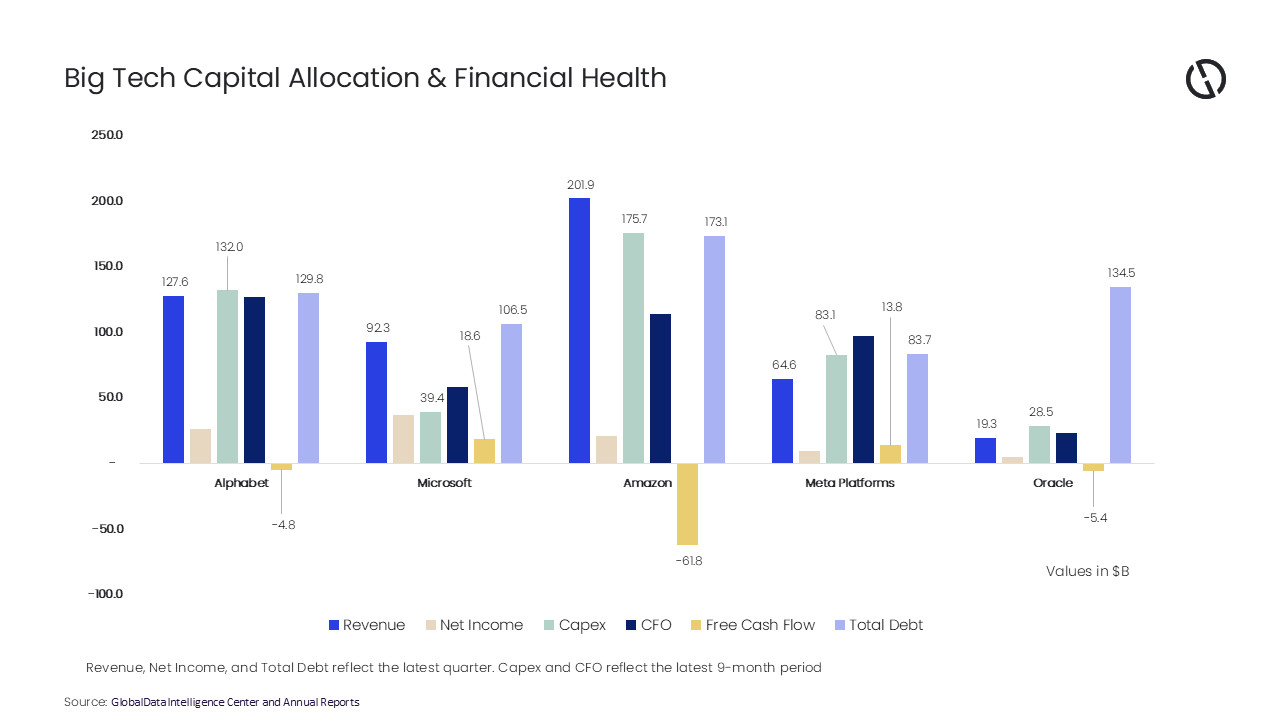
GlobalData’s analysis highlights a widening gap between healthy revenue growth and the amount companies are spending to expand their infrastructure.
Alphabet provides one example, although its quarterly earnings and cumulative spending figures cover different periods. Its latest filing records capital expenditure of approximately $132 billion during the first nine months of 2026, against operating cash flow of approximately $127.1 billion over the same period. Spending therefore exceeded cash generated from operations by around $4.8 billion. sec.gov
Across the other companies examined, GlobalData reports negative free cash flow at Amazon and Oracle, alongside declining but still positive free cash flow at Meta and Microsoft.
Free cash flow measures the money remaining after capital expenditure. Pressure on this figure can leave businesses with less flexibility to fund further expansion, make acquisitions or return money to shareholders.
Murthy Grandhi, Company Profiles Analyst at GlobalData, comments:
“The financing challenge is becoming equally important. With internal cash generation increasingly insufficient to fund infrastructure expansion, the technology industry is turning towards corporate bonds, private credit, infrastructure funds and special-purpose vehicles (SPVs). Oracle’s financing strategy provides a concrete example: it raised $43 billion in debt during fiscal 2026 alongside $5 billion in equity financing.”
Borrowing Adds Another Cost To The AI Race
GlobalData warns that debt-funded expansion introduces costs beyond the depreciation of buildings, servers and other infrastructure.
Interest payments and refinancing costs could weigh on profits and earnings per share, particularly if revenue from AI services falls short of expectations. Companies could consequently face difficult decisions over dividends, share buybacks, staffing and which projects receive further investment.
The risk also extends to the useful life of the technology being purchased. If computing equipment becomes outdated faster than anticipated, or demand for capacity weakens, businesses could face continuing financing commitments against assets delivering lower returns.
For technology suppliers and customers, this places greater importance on commercially viable applications and reliable demand, alongside technical progress.
Competition Extends Across The Supply Chain
The spending surge is also part of a wider contest for technological leadership.
GlobalData points to US support for domestic AI infrastructure and China’s efforts to strengthen semiconductor self-reliance, develop domestic models and expand industrial applications.
Competition increasingly encompasses the entire technology supply chain, including advanced chip production, high-bandwidth memory, cloud platforms and the applications businesses ultimately purchase.
The company also identifies potential inflationary pressures. Higher demand for memory, servers and energy could increase costs across the technology sector and eventually affect consumer electronics prices. These remain potential consequences rather than certain outcomes.
Investors Look Towards A Test Of AI Economics
Grandhi concludes:
“GlobalData sees 2027 could become a critical test of AI economics. Global equity markets may increasingly differentiate between companies generating measurable AI revenues and those relying on future expectations. Emerging markets could benefit through semiconductor manufacturing, memory exports, data centres and power infrastructure, but remain vulnerable to imported technology costs, capital outflows and inflationary pressures.
“The survival strategy is disciplined capital allocation. Companies must prioritize commercially viable AI applications, improve infrastructure utilisation, secure long-term customer commitments and demonstrate returns on invested capital. They must also maintain manageable leverage, protect core business profitability and preserve shareholder returns. The winners of this AI cycle will not necessarily be those spending the most, but those converting technological leadership into recurring revenues, sustainable earnings and durable free cash flow.”
Sources/References
GlobalData press release supplied: “Big Tech debt-driven AI race tests investor confidence, says GlobalData”.
Alphabet regulatory filing: https://www.sec.gov/Archives/edgar/data/1652044/000165204426000084/goog-20260930.htm