The UK ranks among the world’s leading countries for online interest in wearable technology, with new research revealing particularly strong demand for fitness trackers and branded smartwatches.
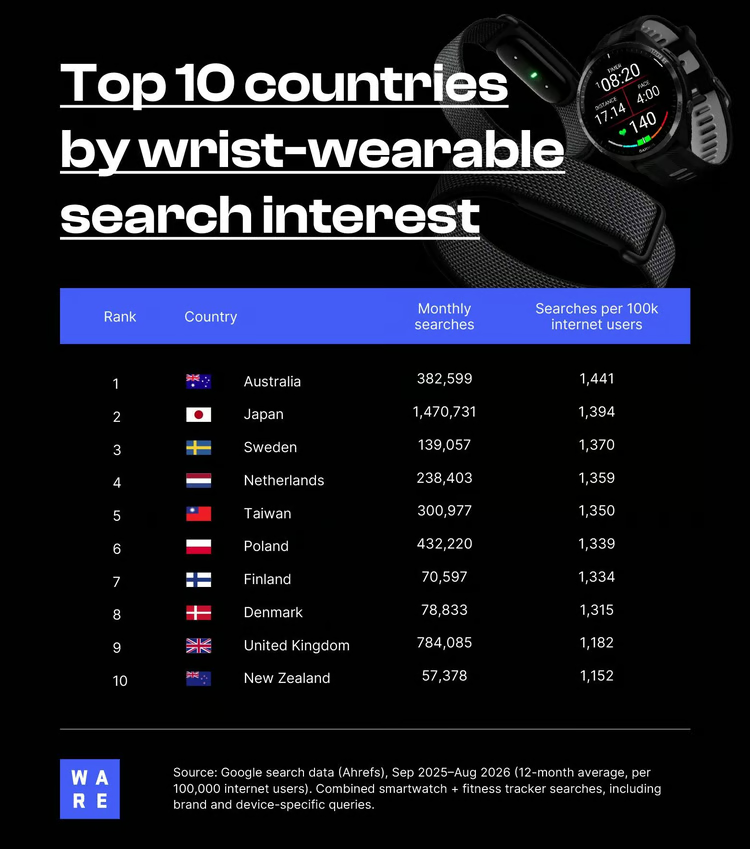
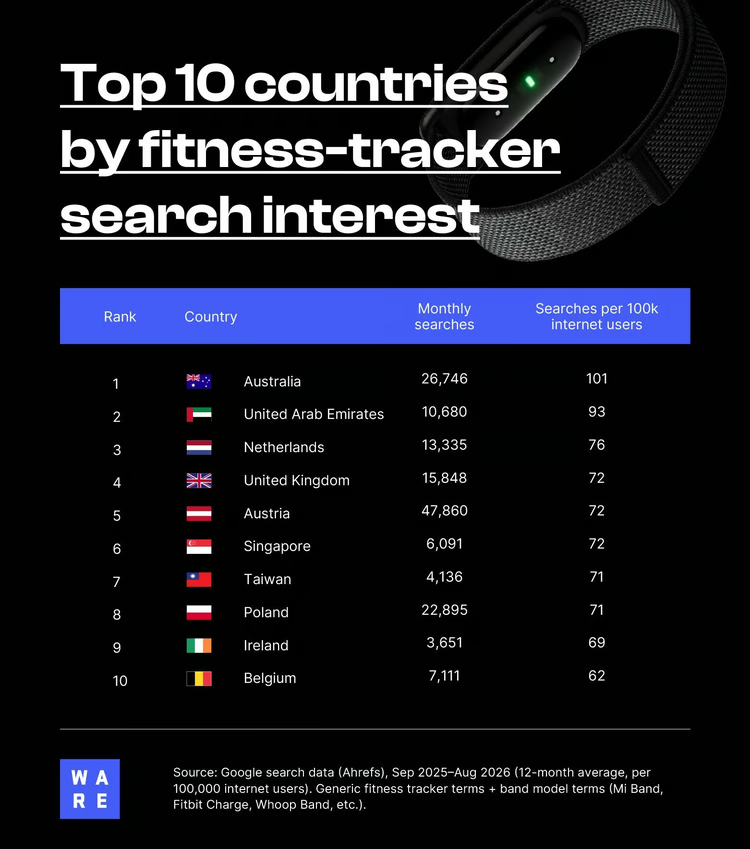
An international study by wearable technology publication Wareable has placed the UK ninth globally for wrist-wearable searches per 100,000 internet users and fourth for searches specifically relating to fitness trackers.
The research examined 12 months of Google search data across 101 countries, comparing interest in smartwatches, fitness bands and other wrist-worn devices.
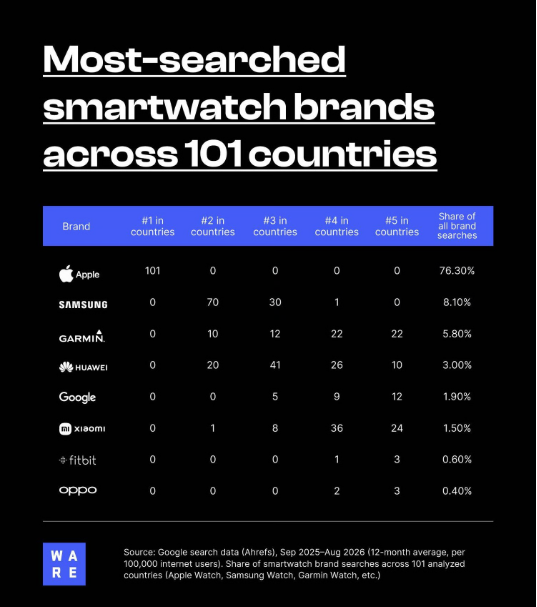
Apple emerged as the dominant brand worldwide, accounting for 76.3% of brand-related searches and taking first place in every country analysed.
However, the findings also revealed differences in consumer preferences, with Garmin attracting more searches than Samsung in several major markets, including the UK, United States and Australia.
UK Consumers Show Strong Interest in Wearable Technology
Wearable devices have developed considerably beyond their original role as simple step counters.
Modern smartwatches and fitness trackers can monitor activity levels, record workouts, track sleep patterns and provide insights into heart rate and other health-related measurements.
Many also offer smartphone notifications, contactless payments, navigation and safety features.
According to Wareable’s research, British internet users are particularly interested in this growing category of consumer technology.
The UK ranked ninth for overall wrist-wearable searches relative to its internet-using population, placing it among the top 10 countries in the study.
Its fourth-place position for fitness tracker searches suggests substantial interest in devices designed primarily for activity monitoring, exercise and personal health tracking.
Dedicated fitness trackers typically offer a different proposition from full-featured smartwatches, often prioritising activity data, battery life and continuous monitoring over smartphone-style functionality.
However, the distinction between the two categories has become less clear as manufacturers introduce increasingly sophisticated health and fitness features across their product ranges.
Apple Accounts for More Than Three-Quarters of Brand Searches
One of the most striking findings was Apple’s dominance of branded wearable searches.
The technology company accounted for 76.3% of wrist-wearable searches associated with specific brands across the countries analysed.
Apple ranked first in all 101 countries, highlighting the global visibility of the Apple Watch range.
This does not necessarily mean that Apple accounts for the same proportion of wearable device sales, as search activity measures online interest rather than purchases or market share.
Nevertheless, the figures demonstrate the strength of Apple’s brand recognition within the smartwatch market.
Apple Watch devices combine smartphone connectivity with fitness and health features, including activity tracking, heart rate monitoring and workout recording.
Depending on the model, additional capabilities can include ECG recording, fall detection and other health-related functions.
The popularity of these features has helped position smartwatches as everyday technology products rather than accessories used exclusively by fitness enthusiasts.
Garmin Outperforms Samsung in Several Major Markets
Although Apple dominates overall brand searches, the study identified significant interest in alternative manufacturers.
Garmin generated more searches than Samsung in the UK, United States and Australia, among other countries.
Garmin has established a strong presence in the sports and fitness wearable market, offering devices designed for runners, cyclists, swimmers and outdoor enthusiasts.
Its watches often emphasise detailed training metrics, GPS tracking, endurance performance and longer battery life.
Samsung, meanwhile, offers smartwatches with a broader focus on everyday connected features, health monitoring and integration with Android smartphones.
The comparison suggests that consumers researching wearable technology may be considering different priorities depending on their intended use.
Someone looking for detailed running statistics or outdoor navigation may be attracted to a specialist sports watch, while another buyer may prioritise messaging, payments and smartphone integration.
Importantly, higher search volumes do not necessarily establish which manufacturer is selling more devices in any particular country.
Brand Names Are Driving the UK’s Wearable Searches
Wareable’s analysis also highlights an important difference between how consumers search for wearable technology and how researchers might measure interest in the category.
Generic search terms such as “smartwatch” or “fitness tracker” account for only part of the online activity.
Many consumers instead search directly for products or manufacturers they already recognise, using terms such as “Apple Watch”, “Garmin Watch” or “Whoop Band”.
This has a substantial impact on international rankings.
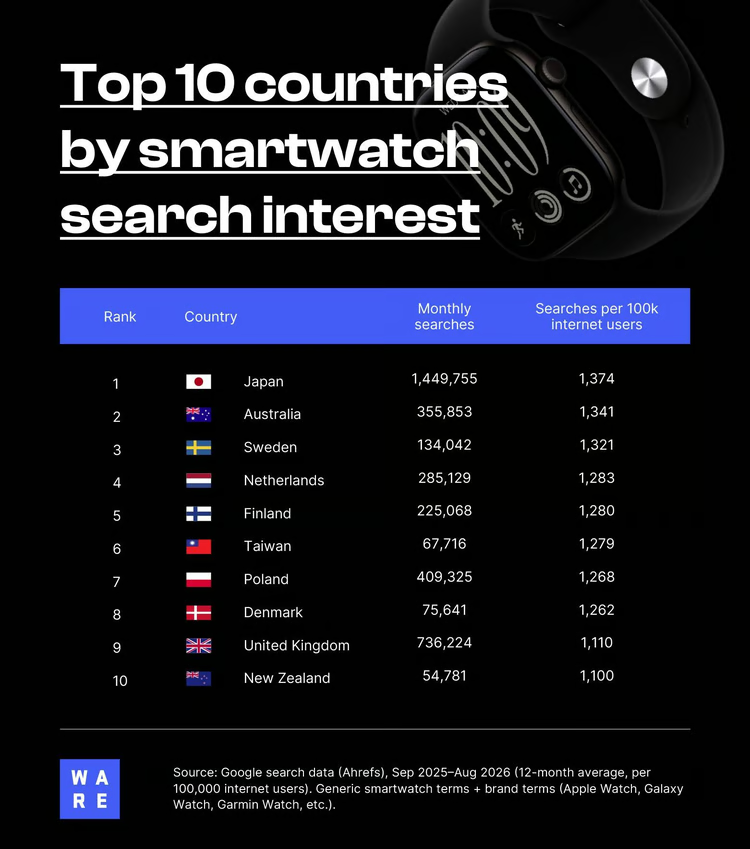
When only generic smartwatch search terms were considered, the UK ranked 50th.
However, when brand and device-specific searches were included, the UK climbed to ninth place.
According to the study, brand-related keywords accounted for 92.8% of the UK’s smartwatch searches.
Australia showed a similar pattern, moving from 38th to second place when branded searches were included, with brand-related keywords accounting for 92.4% of its searches.
Taiwan experienced an even more dramatic change, climbing from 82nd to sixth place, with brand searches accounting for 98.5%.
These findings suggest that consumers in some markets are already familiar with particular wearable brands and are more likely to research named devices than search for general product categories.
For manufacturers, retailers and technology marketers, this distinction could be important when assessing consumer awareness and developing online search strategies.
What Does the Research Mean for Wearable Technology Buyers?
The popularity of wearable devices reflects the growing number of functions available in products that can be worn throughout the day.
However, consumers considering a smartwatch or fitness tracker should look beyond brand recognition and consider which features are genuinely useful to them.
Battery life remains an important consideration, particularly for people who want continuous sleep tracking or who regularly take part in long outdoor activities.
Compatibility is another factor. Some smartwatches work only with particular smartphone operating systems, while others offer broader connectivity but may have limitations when paired with certain devices.
Health monitoring capabilities also vary considerably.
Although many wearables can provide useful information about activity levels, sleep and heart rate trends, not all measurements are suitable for medical diagnosis.
Consumers should check which features are available on a particular model, whether they require subscriptions and whether any advertised medical functions have the appropriate regulatory clearance.
Data privacy is also worth considering, as wearable devices can collect detailed personal information about daily routines, activity and health-related measurements.
Search Interest Does Not Always Translate Into Sales
While Wareable’s research provides an indication of global consumer curiosity, search volumes should not be confused with actual ownership or purchasing behaviour.
People may search for wearable devices to compare prices, read reviews, troubleshoot existing products or investigate new features without intending to buy.
The study also measures interest relative to the number of internet users in each country, rather than simply comparing total search volumes.
This approach helps identify markets where wearable-related searches are particularly frequent in proportion to the online population.
It also demonstrates why including branded searches is essential when assessing a technology market where consumers are already familiar with major manufacturers.
With the UK ranking fourth for fitness tracker interest and ninth for overall wrist-wearable searches, the findings point to a substantial British audience researching devices that combine personal technology, exercise monitoring and everyday convenience.
As manufacturers continue to develop new health features, sports tracking capabilities and connected services, wearable technology is likely to remain an important area of competition within the consumer electronics industry.
Sources/References
Wareable – Study: Where Wearable Interest Is Booming Worldwide
https://www.wareable.com/news/study-where-wearable-interest-is-booming-worldwide
Research details supplied by Wareable, November 2026.