- Almost 68,000 people search for ‘Have I Been Pwned’ every month as data breach fears dominate online privacy worries
- More than 100,000 monthly searches relate to changing passwords, revealing rising security anxiety
- Phishing scam queries hit 40,000 monthly searches as the public seeks to protect their personal information
The data breach checker “Have I Been Pwned” has topped the list of the UK’s most searched online privacy tools, receiving an average of 67,542 monthly searches. While UK’s Online Safety Act has made significant strides in holding online platforms accountable for harmful content, new research reveals a concerning gap in personal cybersecurity awareness among British internet users.
The figures come from a new study by AstrillVPN which analysed search data from Google Keyword Planner to identify the privacy concerns most frequently searched by Britons. The results show password security and anonymous browsing are dominating the public’s attention.
“Have I Been Pwned” – 67,542 monthly searches
The data breach checker tops the chart by a wide margin. Britons are searching in droves to find out if their personal information has been exposed in data leaks. The term attracted more than 67,000 monthly searches, outpacing every other privacy concern in the country.
“Incognito mode” – 38,650 monthly searches
The second-highest privacy concern relates to private browsing. Many users are turning to their browser’s incognito function in a bid to avoid being tracked online. While it only hides local browsing history, it remains the UK’s second most searched privacy tool.
“Tor browser” – 33,217 monthly searches
The Tor browser, known for anonymizing web activity through a multi-layered network, comes in third. The high search volume highlights a strong public interest in more advanced privacy solutions.
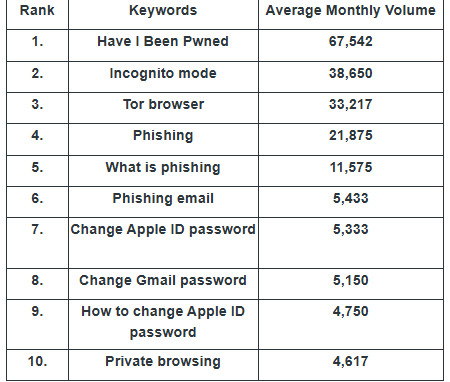
“Phishing” – 21,875 monthly searches
Phishing scams rank fourth and continue to cause widespread concern and grow more complex with each passing year. The generic term “phishing” earned more than 21,000 searches per month, reflecting anxiety about online scams, phone scams, and cyber threats.
“What is phishing” – 11,575 monthly searches
“What is phishing” ranks fifth. This search term suggests that people are not only worried about scams, they’re actively trying to understand how phishing works to avoid them.
Positions six through ten are populated with searches for “Phishing email” at 5,433, “Change Apple ID password” at 5,333, “Change Gmail password” at 5,150, “How to change Apple ID password” at 4,750, and “Private browsing” at 4,617.
Interesting patterns among the findings:
- Passwords saw the most interest overall, with more than 100,000 combined monthly searches for how to change them across various sites.
- Private browsing terms like “Incognito mode” (38,650 searches) and “Tor browser” (33,217) proved popular.
- Phishing-related searches also ranked high, with 21,875 looking up the general term “Phishing”, 11,575 wanted to find out “What is phishing”, and 5,433 wanted to better understand “Phishing email.”
Arqam Zafar, Marketing Director at AstrillVPN, said the findings reveal a growing privacy awareness among UK internet users, stating,
“These search trends show British internet users are privacy-conscious. The high volume of searches for data breach checks and password changes indicates people understand that they are at risk online, but may not be fully aware of how to protect themselves.
“I like to think of online security like it’s a house. If you imagine your password is the key to your front door, you might treat it differently. For example, many people store passwords in browsers, but if you are infected with malware, or someone gains access to your computer, they will have access to everything you have saved. To go back to the previous analogy, it’s like leaving your house keys on the windowsill of an open window.
“It’s a common belief that swapping characters in passwords will be enough, but changing things such as the word “Password” to “Pa$$w0rd” is a practice more common than you may think. Passphrases are a much more secure option. If you are struggling to create one, take random words and create phrases from them, such as “Chocolate monster kitten”. This strategy is easy to remember, but tough to crack”.
Image credit: Instant images